ENGINEERING
THE SCIENCE OF OFFSET
Understanding scrub radius, clearance, and how offset affects handling characteristics.
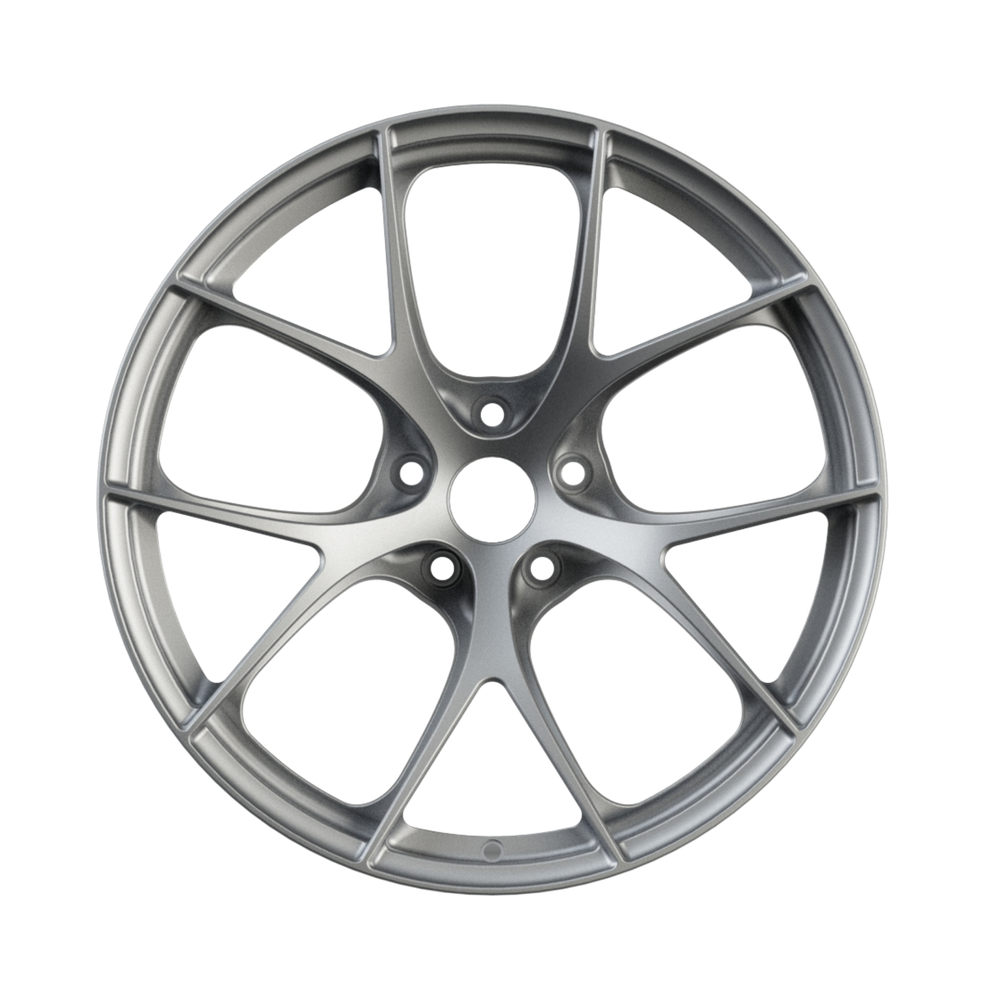
The RRT-Ultra is one of the most highly optimized forged car wheels available today. It is engineered beyond what most manufacturers are willing to pursue, due to its ultra-deep side cuts, thin-wall sections, and complex geometry that significantly increase manufacturing time and cost. Each wheel requires many hours on a 5-axis CNC machine, making it a true engineering-first product rather than a commercially driven one.
The RRT-Ultra was never designed around mass production or margins. It is an exploration of how far a car wheel can be optimized when performance is the only priority. Every feature follows a strict form-follows-function philosophy. Every corner, profile, and cross-section exists to refine load paths, reduce unnecessary material, and improve structural efficiency.
This approach results in an extreme strength-to-weight ratio that places the Ultra ahead of competing forged wheels. To our knowledge, there is no other forged 6061-T6 aluminum car rim that is lighter while maintaining comparable load-holding capability. These are car rims built for drivers who understand that real performance is measured in data, not appearance.
If you demand the highest level of performance from your car wheels, the RRT-Ultra delivers reduced unsprung mass with exceptional lateral, vertical, and torque load capacity. Lower rotational inertia translates directly into sharper steering response, improved braking feel, and more efficient acceleration.
For those who demand nothing less than the best for their car, the RRT-Ultra represents engineering without compromise.

After extensive large-scale testing and development, the RRT-Ultra emerged as a benchmark in advanced forged wheel design. Extensive 5-axis CNC machining allows precise thin-wall sections and ultra-deep spoke cuts that maximize weight reduction while preserving structural integrity.
Many lightweight car wheels on the market focus only on reducing mass, often at the expense of stress management and long-term durability. At RRT, we take a different approach. Every RRT-Ultra wheel is developed using calculations, stress analysis, and real-world data to ensure that reduced weight does not compromise strength or safety.
If you are searching for car rims that are genuinely lightweight yet structurally sound, the RRT-Ultra stands apart.

The RRT-Ultra features detailed 5-axis CNC machining that extends deep into the spoke structure and toward the barrel. This process removes excess material from low-stress areas, reducing rotational mass and wheel inertia.
The result is noticeable improvement in braking response, acceleration, and overall vehicle feedback. Due to the time-intensive machining process and high production cost, this level of detail is rarely applied in modern car wheel manufacturing.
RRT chooses to apply it anyway.
Our forged car wheels are built without shortcuts. Every machining hour serves a purpose, and every design decision is made to extract maximum performance from the material. This philosophy is what defines the RRT-Ultra and separates it from conventional aftermarket wheels.

 Gloss Black
 Gloss White
 Polished Aluminum
 Black Jack
 Evo Grey
 Sterling Gold
 Autumn Black
 Lazer Rootbeer
 Illusion Copper
 Illusion Blueberry
 Satin Bronze Chrome
 *Actual colors may vary due to current lightings.*
| kg | kg | kg | kg | kg | |||||||||
| 17x7 | 5.8 | 18x8 | 6.6 | 19x8 | 7 | 20x9 | 7.5 | 21x10 | 9.35 | ||||
| 17x8 | 6 | 18x8.5 | 6.75 | 19x8.5 | 7.2 | 20x9.5 | 7.8 | 21x10.5 | 9.55 | ||||
| 17x9 | 6.2 | 18x9 | 6.95 | 19x9 | 7.35 | 20x10 | 8.1 | 21x11 | 9.8 | ||||
| 18x9.5 | 7.05 | 19x9.5 | 7.5 | 20x10.5 | 8.35 | 21x11.5 | 10 | ||||||
| 18x10 | 7.25 | 19x10 | 7.7 | 20x11 | 8.55 | ||||||||
| 18x10.5 | 7.4 | 19x10.5 | 7.85 | 20x11.5 | 8.75 | ||||||||
| 18x11 | 7.6 | 19x11 | 8.1 | 20x12 | 9.15 | ||||||||
| 18x11.5 | 7.8 | 19x11.5 | 8.4 | ||||||||||
| 19x12 | 8.7 |
** weight specs may verify due to different requirements such as brake clearances and load requirements **
| Aspect | RRT-Ultra Forged Wheels | Cast / Flow Formed Wheels |
|---|---|---|
| Material | 6061-T6 wrought (forged) aluminum | A356 cast aluminum alloy |
| Manufacturing process | Forging from solid billet | Casting / flow forming |
| Yield strength | ~280 MPa | ~190 MPa |
| Elongation before failure | ~15% | ~3–5% |
| Deformation tolerance | Very high | Limited |
| Failure behavior | Deforms progressively | Fractures more easily |
| Weight vs strength | Lighter for the same strength | Heavier to reach similar strength |
What this means in real terms:
For an equivalent design, a forged wheel can withstand roughly 30% more force before deformation and up to 3× more deformation before material failure. This is why forged wheels can be both lighter and significantly tougher.
| Topic | Explanation |
|---|---|
| Why 6061 can’t be cast | 6061 is a wrought alloy. When cast, contraction during cooling causes internal tearing |
| Casting speed vs forging | Casting: ~3 minutes per wheelForging (RRT Extreme): up to ~1800 minutes |
| Why casting is cheaper | Faster cycle time and simpler tooling |
| Why strength is higher in forging | Grain structure is aligned and compacted during forging |
| Why A356 is used for casting | High silicon content improves flow and prevents hot tearing |
| Trade-off of A356 | Easier to cast, but sacrifices strength and durability |
| Engineering Focus | RRT-Ultra Approach |
|---|---|
| Load path design | Smooth, uninterrupted load transfer from barrel to bolt seat |
| Stress concentration | Minimized to the practical limit |
| Spoke-to-barrel interface | Optimized geometry; webbed structures in advanced series |
| Lateral load resistance | Designed for extreme lateral impacts and racing scenarios |
| Real-world abuse tolerance | Proven in wheel-to-wheel contact and off-track excursions |
| Industry comparison | Engineered beyond minimum regulatory strength requirements |
| Design Principle | RRT-Ultra Execution |
|---|---|
| Polar moment of inertia | Maximized through large, hollow, thin-wall profiles |
| Visual appearance | Chunkier spokes, but lighter and stronger |
| Structural technique | Aggressive side cuts, hollow box sections, webbing |
| Result | Higher stiffness at lower mass |
| Engineering analogy | Large hollow tube is stiffer and lighter than a small solid one |
| Outcome | Light does not equal weak when geometry is optimized |
| Fitment Aspect | RRT-Ultra Advantage |
|---|---|
| Production method | Custom built per vehicle |
| Use of adapters | No center rings, wobble bolts, or spacers |
| Brake clearance | Supports large brake systems (e.g. 390mm setups) |
| Stagger options | Reverse stagger, non-standard widths, offsets |
| Performance impact | Improved handling, reduced unsprung mass |
| Competitive edge | Fitment optimized for camber, wide fenders, and track use |
Bottom line:
Why invest in a lightweight wheel only to compromise it with heavy spacers? Proper fitment is a performance multiplier, not a cosmetic detail.
CUSTOM GALLERY
Explore detailed images of this product from every angle.


Every wheel in this series is forged and machined to tolerances that exceed conventional standards.
Aerospace-grade billet aluminum, heat-treated to T6 specification.
Five-axis CNC machining ensures micron-level precision on every surface.
T6 heat treat process maximizes strength-to-weight ratio.
Our forging process aligns grain structure for superior strength at a lower weight.
Up to 30% lighter than cast equivalents, reducing rotational mass.
Forged grain structure yields higher tensile and fatigue strength.
Dynamic balancing to within 5 grams for smooth high-speed rotation.
| Specification | RRT Forged | OEM Cast |
|---|---|---|
| Weight (19x8.5) | 50% Lighter / 15% Lighter JFW | 12.1 kg |
| Tensile Strength | ≥310 MPa | ≤220 MPa |
| Fatigue Life | 1,000,000+ cycles | ~500,000 cycles |
| Porosity | None | Visible micro-voids |
Each fitment is engineered to clear big brake kits and maintain optimal suspension geometry.
Precision-bored center bore matches your vehicle hub for vibration-free fitment.
Designed to clear multi-piston calipers without spacers.
Custom offset engineering for perfect flush fitment with the fender.
Each fitment is load-rated to exceed vehicle manufacturer specifications.
Deep-dive articles on the engineering behind the RRT Forged Weels.
Understanding scrub radius, clearance, and how offset affects handling characteristics.
Finite element analysis behind our signature I-beam spoke reinforcement design.
{"one"=>"Select 2 or 3 items to compare", "other"=>"{{ count }} of 3 items selected"}